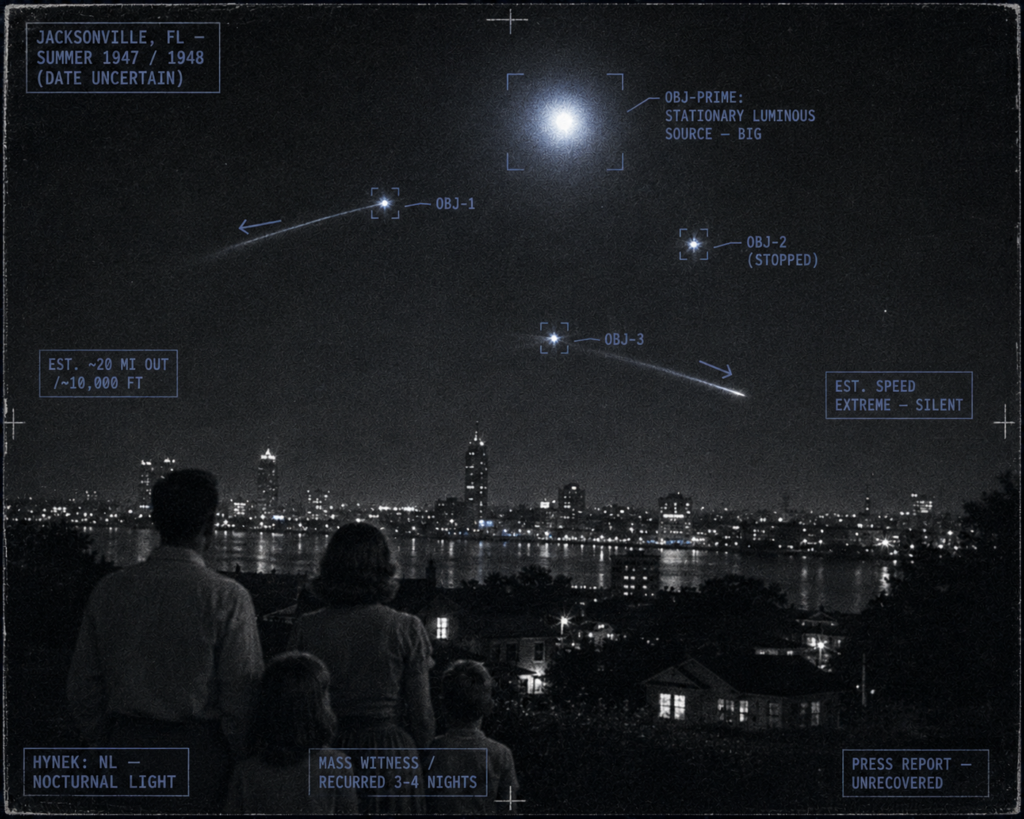
One big bright light over Jacksonville launches three darting lights — a mass-witness nocturnal event, summer 1947 or 1948, that recurred for several nights and made the local paper.
THINK ABOUTIT UFO | UAP SIGHTING REPORT
1947 or 1948: Jacksonville Florida One Big Bright Light
For three or four nights running in the summer of 1947 or 1948, much of Jacksonville, Florida stopped and looked up. High over the city — by one witness’s pilot-trained estimate about twenty miles out and ten thousand feet up — a single enormous bright light hung motionless, and out of it came three smaller lights that sat for a moment, then tore across the sky in different directions, halted dead, and shot off again, over and over for the better part of an hour before folding back into the parent light, which then simply vanished. No sound. No aircraft the military would admit to. So many people called it in that the local paper ran a story, and some Jacksonville residents reportedly believed they were watching the end of the world. Then, after the third night, the coverage stopped — and the record went quiet for the better part of a lifetime.
Date: 1947 or 1948 (summer; exact year uncertain)
Sighting Time: Unknown (nighttime)
Day/Night: Night
Location: Jacksonville, Florida
Urban or Rural: Urban (observed city-wide)
No. of Entity(‘s): na
Entity Type: na
Entity Description: na
Hynek Classification: NL (Nocturnal Light)
Duration: About an hour
No. of Object(s): Multiple — four total (one large stationary light plus three smaller lights emerging from it)
Size of Object(s): Large primary light; three smaller secondary lights
Description of the Object(s): One big, brilliant bright light held a fixed position high in the night sky. Three smaller bright lights emerged from it, remained stationary for about a minute, then shot across the sky in different directions — covering an estimated twenty miles before coming to a complete stop, occasionally pausing before darting off on a new heading. All three smaller lights behaved this way for roughly an hour while the large light remained in place. The three then returned to the large light, which disappeared. The sequence recurred over three to four consecutive nights in the same part of the sky.
Shape of Object(s): Not determined — observed strictly as luminous points/orbs; no structure discernible
Color of Object(s): Brilliant white/bright (three smaller bright lights emerging from one larger bright light)
Distance to Object(s): Estimated about 20 miles out
Height & Speed: Estimated altitude about 10,000 feet; the large light remained stationary; the three smaller lights were estimated by the witness to travel at extreme speed (stated as upward of ~10,000 mph), with instantaneous stops and direction changes; all movement silent
Number of Witnesses: Mass — the witness’s family plus, by the account, approximately half the city, sufficient to prompt a local newspaper story
Special Features/Characteristics: Parent light ejecting and reabsorbing smaller lights; right-angle/instantaneous stops and starts; total silence; multi-night recurrence in a fixed sky location; mass civilian witnessing and press coverage; military reportedly stated no aircraft were airborne at the time
Case Status: Insufficient Data
Source: First-person witness account submitted to Think About It Docs; references an unrecovered contemporaneous Jacksonville newspaper report (summer 1947 or 1948). Source status: UNVERIFIED.
Summary/Description: A witness who was about ten years old at the time reports that his entire family, and much of Jacksonville, watched a large stationary bright light high over the city release three smaller bright lights that darted across the sky at extreme speed with abrupt stops and direction changes for about an hour before returning to the parent light, which then vanished. The display recurred for three to four nights. The witness, later a pilot, based his altitude, distance, and speed estimates on his flight experience, and notes the objects were silent — unlike the PBY trainers from the local Navy base, audible thirty miles away — and that the military denied having aircraft aloft. He recalls a local newspaper story that ceased after the third day.
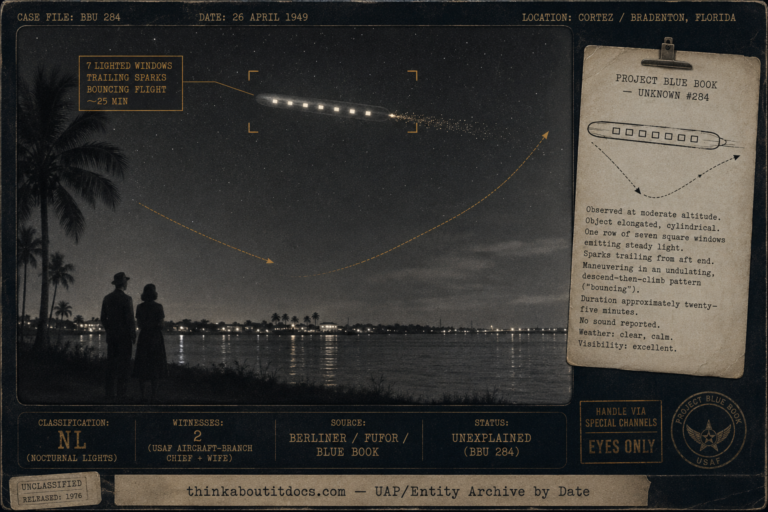
Related Cases: 1949 Cortez-Bradenton, Florida Sighting | 1952 West Palm Beach, Florida Sighting | 1960 Sarasota “Elliptical UFO with Portholes,” Florida | broader 1947–1948 nationwide wave (NL and DD reports) | Vero Beach, Florida (regional association)
DETAILED REPORT
The account is a first-person recollection, submitted to Think About It Docs by a witness who states he was about ten years old at the time of the event and who describes himself as having become a pilot with substantial flight time in his own aircraft. By his recollection, in the summer of 1947 or 1948, he and his entire family observed a single large, brilliant light fixed high in the night sky over Jacksonville, Florida. He places it at roughly twenty miles distant and about ten thousand feet in altitude — estimates he explicitly attributes to his later aviation experience rather than to any instrument.
The behavior he describes is the case’s defining feature. From the large stationary light, three smaller bright lights emerged and held position for about a minute. Each then accelerated across the sky in a different direction, covering an estimated twenty miles before stopping completely; the lights would sometimes hover briefly before darting off again on a new heading, and all three repeated this stop-start, direction-changing pattern for roughly an hour. Throughout, the large parent light remained in the same spot. At the end of the display the three smaller lights returned to the large light, which then disappeared. The witness reports that this same sequence recurred in the same region of the sky over three or four consecutive nights.
Two elements elevate the account above a single-observer anecdote. First is the scale of witnessing: the witness states that approximately half the city telephoned in reports and that a local newspaper published a story because so many residents across Jacksonville had seen the lights, with some fearing it signaled the end of the world. Second is the witness’s affirmative testimony on what the objects were not — he notes that the Navy base then training pilots in PBY aircraft produced engine noise audible from thirty miles away, whereas these lights were completely silent; that jet aircraft were not yet in production and could not have performed at the estimated speeds in any case; and that the military stated it had no aircraft airborne at the time. Set against these strengths is the central limitation: the entire record, as held, rests on one anonymous, retrospective submission written many years after the fact, and the contemporaneous newspaper coverage it cites has not been recovered. The witness himself notes that he does not know how to obtain the newspaper record and that the press fell silent after three days. The extraordinary quantitative claims — particularly the ten-thousand-mile-per-hour speed — are sincere pilot estimates but remain uncorroborated, as does the report of military denial. The account is internally coherent, specific, and credible in tone; it is also, at present, unverified.
RESEARCHER’S NOTES
The Parent Light — Jacksonville 1947/48 and the Mass-Witness Event Without a Recovered Record
- Classification Assessment: NL (Nocturnal Light) is correctly applied and should stand. Every observed element is a luminous source seen at night with no discernible structure, no occupants, and no close approach — the textbook NL profile. The “carrier” or parent-and-satellite behavior (one large light deploying and reabsorbing smaller lights) is dramatic but does not change the classification, as nothing structured was resolved and the objects remained at great estimated distance throughout. No Close Encounter category applies, and no Daylight Disc element is present given the nocturnal setting. The object count should read as multiple — four lights total — rather than one.
- Source Chain Assessment: This is the weakest link and the reason for the Insufficient Data status, despite the account’s strength of detail. The record as held is a single anonymous first-person submission, recorded decades after the event, with no name, no exact date, and no recovered documentation. The witness’s self-identification as an experienced pilot is credibility-relevant — it speaks to his competence in judging altitude, distance, and aircraft noise — but it cannot be verified and does not substitute for corroboration. Crucially, the account references a contemporaneous Jacksonville newspaper story that has not been located. Recovery of that story (the Florida Times-Union and other Jacksonville papers of summer 1947–1948 are the logical targets) would transform the case’s standing, potentially corroborating the mass-witness claim with a primary contemporaneous source. Until then the source tier is UNVERIFIED.
- Pattern Context: The account fits the broader 1947–1948 wave both chronologically and behaviorally, while standing out for its multi-night recurrence and parent-satellite dynamics. Stationary “mother” lights deploying smaller maneuvering lights recur throughout the later NL catalog, as do the abrupt right-angle stops and silent high-speed transits the witness describes. The mass-witness, multi-night, city-wide character — with attendant public alarm and press coverage — is the profile of a genuine flap rather than an isolated misperception, which is precisely why locating the press record matters: a city-scale event should have left a documentary footprint. Florida produced several notable cases in the surrounding years, including the 1952 West Palm Beach (Desvergers) encounter.
- Physical Evidence and Evidentiary Weight: There is no physical evidence — no photograph, no instrument reading, no recovered document — and the quantitative parameters are witness estimates rather than measurements. The ~10,000 mph figure and the 20-mile/10,000-foot placements should be presented as the witness’s pilot-informed judgments, not as established values; even an experienced aviator’s night-sky distance and speed estimates carry wide error bars without instrumentation. The strongest evidentiary feature is not physical but social: the claim of mass simultaneous witnessing across a city over several nights, which, if confirmed by the cited newspaper coverage, would constitute meaningful corroboration. As it stands, the case is carried entirely by testimony — compelling, coherent testimony, but uncorroborated — and cannot be raised above Insufficient Data.
The Jacksonville “one big bright light” is one of the more arresting mass-witness accounts in the early Florida record: a recurring, city-wide, silent aerial display with a parent-and-satellite structure, described by a witness whose aviation background lends weight to his read of the sky. If the contemporaneous newspaper coverage he remembers can be recovered, this case has real upgrade potential — a primary, multi-witness, multi-night event with public and possibly official footprints. But the archive deals in what can be documented, and at present this entry rests on a single anonymous recollection recorded long after the fact, with extraordinary figures that are estimated rather than measured and a press record still unlocated. The honest position is Insufficient Data — a credible, vivid, and genuinely intriguing account that the record cannot yet confirm. It stays in the archive flagged as a high-priority candidate for newspaper-archive recovery.