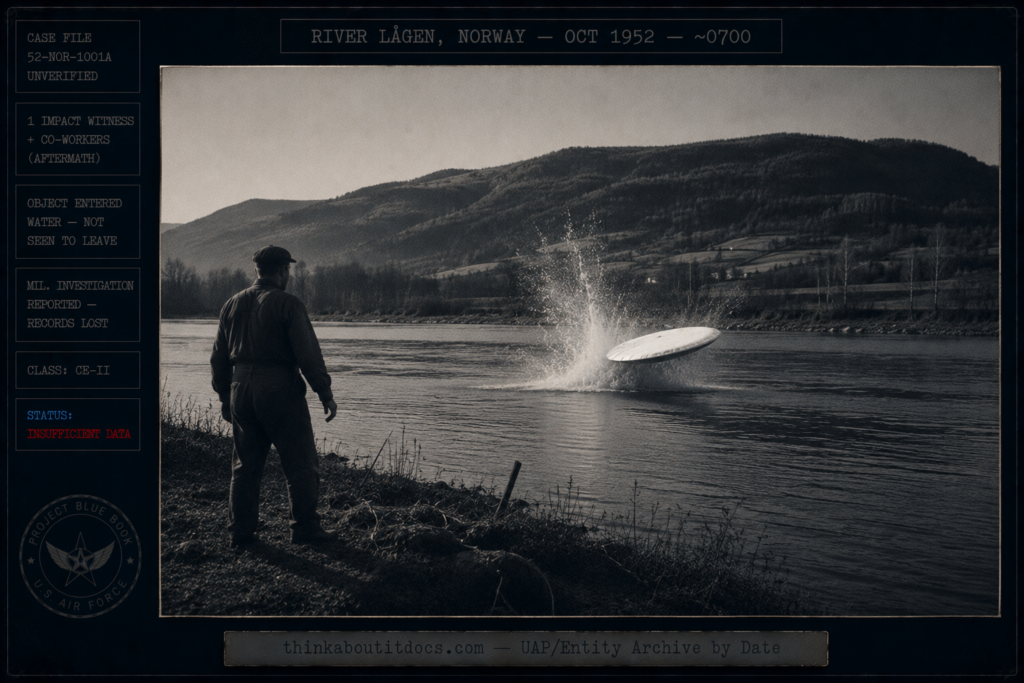
The October 1952 Lågen River event — Johannes Nordlien watched a 4-meter white disc strike the river and vanish; Norway's Defense Command reportedly investigated, but the records are lost. Logged Insufficient Data. (thinkaboutitdocs.com — UAP/Entity Archive by Date)
THINK ABOUTIT UFO|UAP ENCOUNTER REPORT
1952: Object Into the Lågen River, Norway (Johannes Nordlien)
Just before seven on an October morning in 1952, a Norwegian worker named Johannes Nordlien heard a howling, jet-like sound, and a four-meter, snow-white saucer shape tore in low from the west, passed him about a hundred meters off, and struck the River Lågen with a violent splash that threw water meters into the air. There was no fire, no exhaust, no light, no explosion, and the object never came back up. When his co-workers reached the spot the water was still churning.
What lifts this above a lone account is what the cited investigator records around it: according to period press reports, the Norwegian Defense High Command investigated the incident, and the documents have since vanished, possibly destroyed along with the files on Norway’s 1946 ghost-rocket wave. The result is a sober report of an object entering water, with corroborated aftermath and no recovered evidence to settle what it was.
Date: October 1952 (a Thursday; exact date not recorded)
Sighting Time: Shortly before 0700
Day/Night: Day (early morning, clear sky)
Location: River Lågen, Norway (rural)
Urban or Rural: Rural
No. of Entity(‘s): None reported
Entity Type: Not applicable
Entity Description: Not applicable
Hynek Classification: CE-II (Close Encounter II): object at close range associated with a physical effect (the violent splash and churning water); the CE-II rests on that water disturbance, and the daylight structured-disc observation could alternatively support a DD reading
Duration: Seconds (the object crossed and impacted very quickly; the water disturbance persisted briefly before calming)
No. of Object(s): 1 (some witnesses thought they saw two, one behind the other)
Description of the Object(s): A flat, round, saucer-shaped object about four meters in diameter, white as snow, traveling at high speed from the west with a loud howling, jet-like sound that ceased the moment it was seen; it struck the river with a violent splash, threw water several meters up, and did not reappear; no fire, exhaust, light or explosion was observed
Shape of Object(s): Saucer (flat and round)
Size of Object(s): About four meters in diameter
Color of Object(s): White (snow-white)
Distance to Object(s): About 100 meters as it passed the primary witness
Height & Speed: Low and very fast (described as high speed; no instrument measurement)
Number of Witnesses: Primary witness Johannes Nordlien saw the impact; co-workers arrived immediately after and saw the water still churning
Special Features/Characteristics: Object entered water and was never seen to leave (a USO-type impact); loud howling sound that stopped on sighting; violent splash with no fire or explosion; water still “boiling”/churning when co-workers arrived, then quickly calming; per period press, the Norwegian Defense High Command investigated, but the documents have never been recovered
Case Status: Insufficient Data
Source: Ole Jonny Brænne, “Observations of Unidentified Submarine Objects in Norway” (catalog of Norwegian USO reports); “Legend of the Spitsbergen Saucer,” International UFO Reporter, November/December 1992
Summary/Description: Shortly before 7 a.m. on a Thursday in October 1952, Johannes Nordlien heard a howling, jet-like sound and saw a four-meter, snow-white saucer come in fast from the west, pass about 100 meters away, and strike the River Lågen with a violent splash before disappearing beneath the surface. No fire, exhaust or explosion accompanied it; co-workers arriving moments later found the water still churning. Period press reports indicate the Norwegian Defense High Command investigated, but those records are lost.
Related Cases: 1946 & 1952: The Legends of UFO Crashes at Spitzbergen, Norway | Observations of Unidentified Submarine Objects in Norway (source article) | the 1958 Alta fjord “unknown aircraft” water-impact report
DETAILED REPORT
The account comes from the Norwegian researcher Ole Jonny Brænne, whose survey of Unidentified Submarine Objects in Norway gathered the country’s reports of objects associated with water. Shortly before 7 a.m. on a Thursday in October 1952, Johannes Nordlien was waiting for co-workers when he heard a howling, jet-like sound. A saucer-shaped object about four meters across came in at high speed from the west and passed roughly 100 meters from him. It was white as snow, and he saw clearly that it was flat and round. It struck the River Lågen with a violent splash that threw water several meters into the air. There was no fire, no exhaust, no light and no explosion; the loud howling stopped the instant he saw the object. By the time his fellow workers arrived, the water was still churning, and it soon calmed. Some of those present thought they had seen two objects, one behind the other.
Two features make this more than a fleeting glimpse. The aftermath was witnessed by more than one person, since Nordlien’s co-workers independently saw the disturbed, still-churning water. And Brænne records that, according to press reports of the period, the Norwegian Defense High Command conducted an investigation. The inquiry’s records cannot be found; Brænne raises the possibility that they were destroyed along with Norway’s files on the 1946 ghost-rocket wave, leaving newspaper accounts as the only surviving source material.
The churning water is a genuine reported effect, but it is the ordinary consequence of any heavy, fast object hitting a river and it calmed quickly; it is not a burn, an impression or recovered debris. “Crash” is an inference: the object was simply never seen to leave the water and no search of the riverbed is recorded, so whether it sank, submerged under control or was something mundane cannot be determined.
The prosaic candidates deserve a fair hearing because the object was small, fast and seen briefly: a meteorite, a jettisoned drop tank or other aircraft component, or experimental ordnance in an era of heavy Cold War military activity. None fits perfectly, since a meteorite would not typically be described as a flat, snow-white disc and the howling that stopped on sighting is odd for any of them, but none can be excluded on the surviving evidence.
RESEARCHER’S NOTES
The Lågen River Impact: Norway 1952 and the Investigation That Vanished
- Classification, held with a caveat: CE-II is defensible: an object at about 100 meters in association with a physical effect on the environment. But it rests entirely on the water disturbance, so a DD (Daylight Disc) reading is a reasonable alternative.
- A good source: Brænne is a serious, skeptically minded Norwegian investigator whose USO survey is sober catalog work. His entry supplies the corroborating co-workers, the possible second object and the reported Defense High Command inquiry.
- The lost records: An official military inquiry reportedly existed and its documents are gone. The archive records that the inquiry happened and that the loss prevents a firmer conclusion, without treating the missing file as proof of a cover-up.
- Why Insufficient Data: For: a clear daylight observation by a named witness, corroborated aftermath and a reported official inquiry. Against: one witness to the impact, no physical evidence, no surviving documents and several unexcluded mundane explanations.
The Lågen River case is a small, sober and quietly tantalizing entry: no occupants, no glow, only a snow-white disc that came in howling, hit the water hard and never came back, watched by a man whose co-workers arrived to find the river still churning. Its strength is that a national military command thought it worth investigating; its limit is that the investigation’s records are gone.